Mini Split Installation in Chicago, IL
A new system here will heat from October through May and cool from June through August every year. Tell us about the house, and a licensed contractor who covers Cook County will get in touch.
Tell us about the job
It takes about a minute.
Cook County asks a mini-split to run most of the year
Your mini-split will run from October through May to keep the house warm, then switch over for cooling through the summer. That's 11 months of work most years, with only a short stretch in spring and fall where it might sit idle.
Winter nights here average 20°F, cold enough that the heat pump side has to work for its keep. Summer afternoons average 82°F, well within what a properly sized system is rated to handle. Any unit manufactured after January 1, 2023 has to meet 7.5 HSPF2 for heating and 14.3 SEER2 for cooling. Look for those two numbers on whatever you're quoted.
- 8 months
- October through May, your system heats
- 3 months
- June through August, it cools
- 20°F
- the average winter night it heats against
- 82°F
- the average summer afternoon it cools against
NOAA nClimDiv, 1991–2020 normals
In Illinois, HVAC licensing for homes is left to the cities and towns.
Cook County does not run its own HVAC license either, so whether a contractor needs one depends on the city or town where the house sits, not on the county. Some places test and license contractors directly, some register them, and some have no local rule at all. There is no statewide list standing behind any of it. Illinois leaves the whole question to whichever municipality the house is in.
A mini-split installation needs a permit from the local building office in most cities and counties, and an inspection once the work is done. That permit and inspection are separate from any city license and happen regardless of what the local licensing rule is. The inspection is where the installed system gets checked, which matters here because whether a contractor was ever licensed depends entirely on the town, but whether the finished work gets looked at does not.
Source: Illinois General Assembly
- Is a mini split worth it?
- For the right room, yes. A mini split handles a room your ductwork doesn't reach well, like a finished attic, a garage conversion, or an addition, and it heats and cools that space without extending ducts into it. Winters here average 20°F from December through February, and cold-climate mini splits are built to keep producing heat at those temperatures. Whether it makes sense for your house depends on what you're heating and cooling now, so a contractor can look at the specific rooms and tell you what fits.
- How many rooms can a mini split cover?
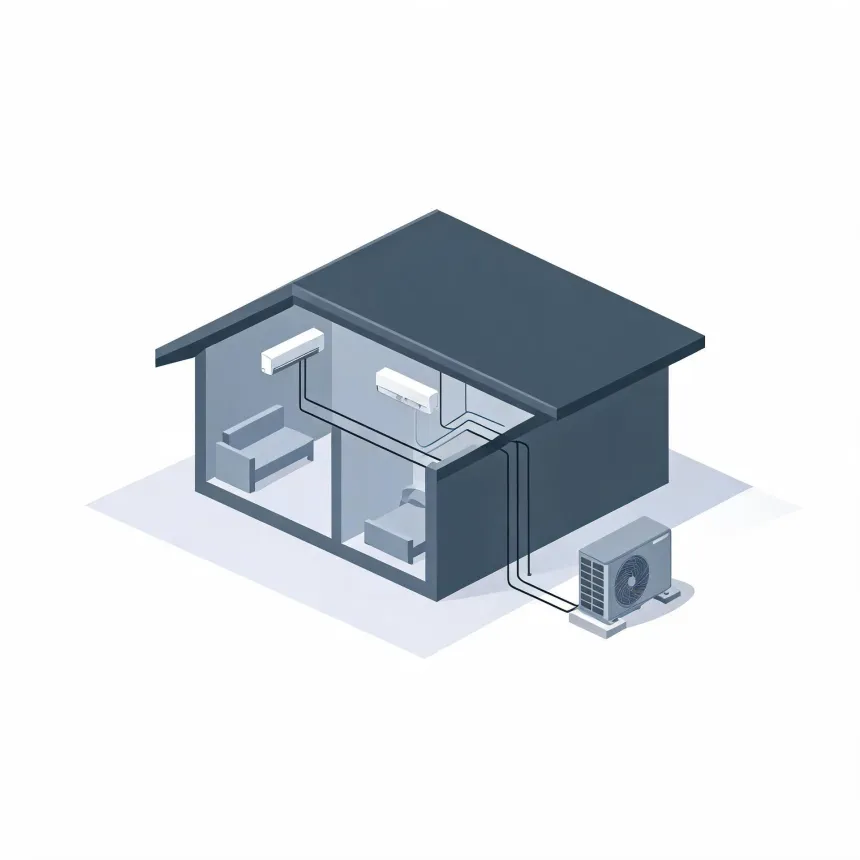
- A single outdoor unit can run one indoor head or several, up to eight on most multi-zone systems. Each indoor head heats and cools the room it's mounted in, and you set each one on its own. More rooms on one outdoor unit means the system has to work harder to keep every zone at its set temperature, so a contractor will size the outdoor unit to the total load of the rooms you want covered, not just count the rooms.
- Can a mini split heat a whole house?
- It can, with enough indoor heads placed to reach every room. Homes here need heat from October through May, eight months of the year, with winter nights averaging 20°F from December through February, so whatever system covers the whole house has to keep up through real cold, not just mild weather. A contractor can work out whether your house has the wall space and layout for full coverage, and whether pairing it with your existing heat source makes more sense than covering every room on the mini split alone.