

Try a fix yourself
You spend today on the breaker, the filter, the thermostat settings, and maybe it's one of those. If it isn't, you've lost a hot afternoon finding out.
Your AC quits on one of those sticky Illinois afternoons and the house starts heating up fast. You want to know what to check yourself before you spend money on a repair call, and what points to the kind of problem that needs a licensed technician instead of a filter change.
Start with the thermostat. Make sure it's set to cool and the setpoint is below room temperature. Next, check the breaker box. Illinois summers push air conditioners hard for months at a stretch, and that strain trips breakers or wears down parts that run fine the rest of the year. If the thermostat looks right and the breaker hasn't tripped, the problem is inside the unit itself, a capacitor, a contactor, or a refrigerant leak, and none of those are safe or legal for you to fix yourself. With power here costing what it does, a struggling system also means a higher bill for as long as it sits broken. A licensed technician can tell you within minutes what's actually wrong.
Check the thermostat is set to cool and below room temperature
Check the breaker for the outdoor unit and the furnace switch
Check the filter and the vents for blocked airflow
A licensed contractor diagnoses the compressor, capacitor, and refrigerant charge


A 90-degree day without cooling doesn't stay comfortable for long, and if you've got pets or older folks in the house, they'll feel it before you do. Your gas furnace still has a part in this. The blower that pushes cooled air through the ducts is the same one that moves heat in January, so if the breaker's off or the filter's packed with dust, nothing moves either direction. Don't keep flipping a tripped breaker back on or forcing a compressor to restart. That habit turns a part a contractor could have fixed into one that needs replacing. Hold off on extra fans or leaving the freezer door open too, since that pulls more from a panel that's already struggling. Close the blinds and keep doors shut to slow the heat coming in while you wait. And keep an eye on your next electric bill. A unit running flat out or short-cycling on a bad part draws more power than it should, and Illinois rates make that noticeable.




A central AC that won't kick on is still pulling on a breaker, a thermostat, and a condensate switch that can each stop it cold, so the fix is often electrical, not refrigerant.
That's why a contractor who checks the simple parts first, before opening up the compressor, gets your air back on without charging you for work you didn't need.


You've checked the thermostat, the breaker, the filter. Nothing brought it back, and the house is still climbing past 80. At that point you're not troubleshooting anymore, you're waiting, and an Illinois summer afternoon doesn't wait well. A compressor that won't start or a system that's low on refrigerant needs gauges and tools you don't have, and the longer it sits the more the heat builds in the walls and the furniture, not just the air. Send the request and someone local who works on this equipment all summer, who knows whether it's the capacitor, the contactor, or something further in, takes it from here. You stop running down parts lists and start waiting on one person who actually knows your system, not a string of callbacks from strangers. That's the point where handing it off is worth more than another hour of guessing in a hot house.

A summer dew point averaging 63°F across Illinois, per NOAA climate data, is the point where air starts to feel heavy instead of just warm. That moisture load is what your AC is fighting all summer, not just the temperature on the thermostat. When it's running right, the system pulls that moisture out along with the heat, which is why the air coming through the vents feels dry as well as cold. When something's off, the first sign often isn't warm air, it's a house that feels damp and sticky even while the unit is running. If you notice that clamminess creeping back, the system is losing ground against the air outside.
NASA POWER T2MDEW county cells weighted by homes


You spend today on the breaker, the filter, the thermostat settings, and maybe it's one of those. If it isn't, you've lost a hot afternoon finding out.
Someone local who works on these systems every summer takes it from here, so the hours you'd spend guessing go back to you instead.
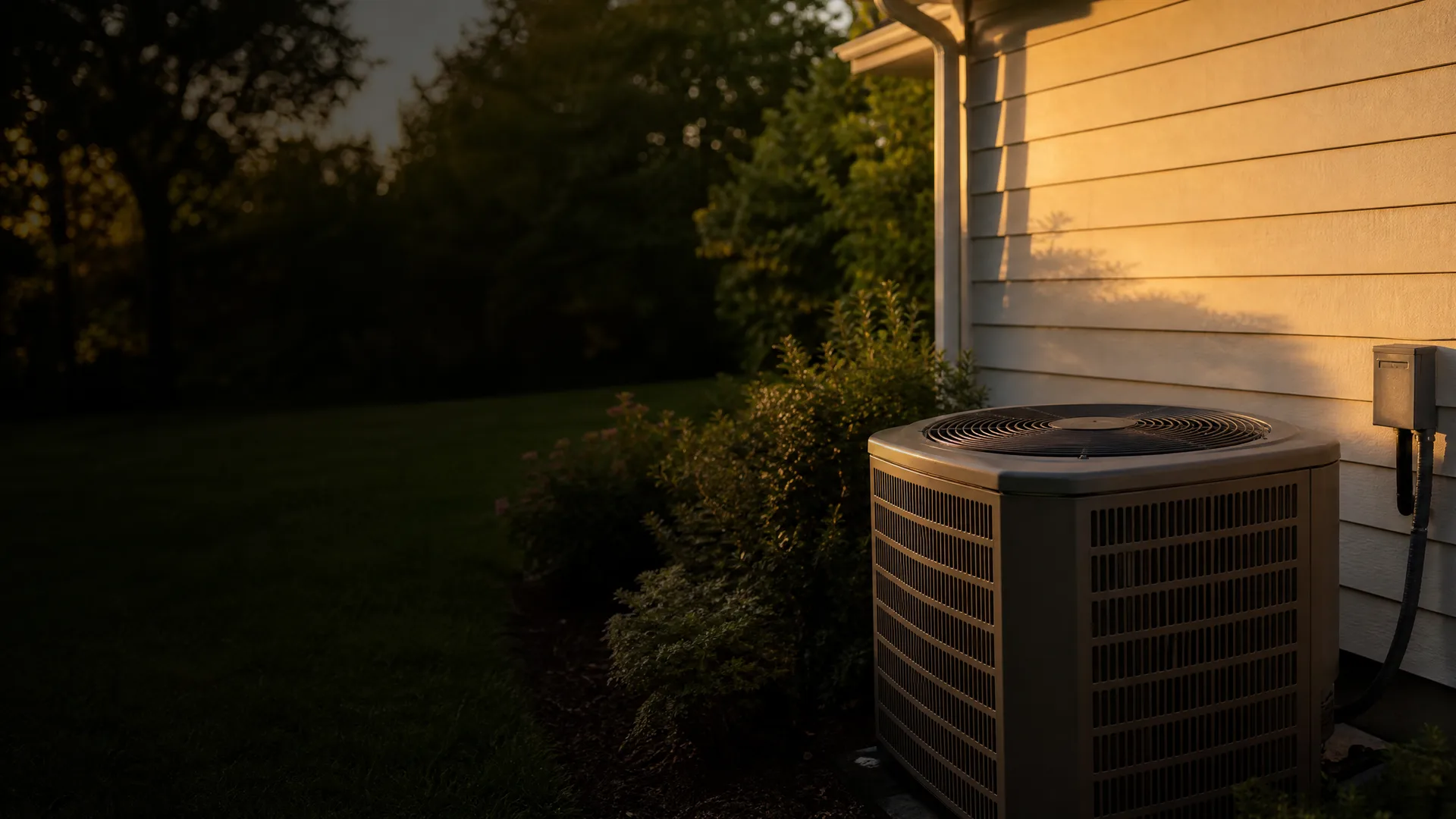
By seven in the evening the sun is low enough to turn gold across the yard, but the air hasn't let up. You're out back checking on the unit because the house felt wrong an hour ago, warmer than it should be with the thermostat set where it always is. The condenser sits there against the fence, and you notice it before you can name it: no hum, no fan turning behind the grille. The bushes next to it are still. Inside, the kids are asking why it's so hot, and you're standing in the grass in the evening light with your phone already in your hand.
At 17.67 cents per kilowatt-hour, an AC that's struggling to keep up costs more to run than one that's fixed right. A weak capacitor or low refrigerant charge makes the compressor work harder for the same cooling, and that shows up on your bill before it shows up as a breakdown.
EIA-861 2025 statewide residential average
When your AC stops working, the order is thermostat, breaker, filter, then a call if none of that brings it back. Most of what fails on a central AC in Illinois is a part a contractor carries on the truck: a capacitor, a contactor, a low refrigerant charge. None of that means a new system. What you get through this page is one licensed contractor local to you, someone who works on these systems every summer and has seen what usually gives out first in houses like yours. Not a list of five companies calling your phone within the hour, just the one who's actually going to show up and know what they're looking at. The house will keep climbing while the unit sits quiet, so once you've ruled out the easy things, the next step is getting someone qualified looking at the compressor and the charge, not waiting out another sticky afternoon to see if it fixes itself.





Only one pro gets your request, so you hear from one company.
It costs nothing to send, and you don't have to hire anyone.