





Musty smell from vents in Waukegan, IL

A galvanized steel round duct with a 90-degree elbow and a white louvered vent cover on one end, shown against a plain gray background.
Find my pro

Why do my vents smell musty?

Every time the air kicks on, you catch it, that damp basement kind of smell drifting out of the vents. It's not strong enough to ignore, but it's there every time, and that makes you wonder what it actually is. With summers here as muggy as they get, you've probably guessed it has something to do with moisture. The question is whether it's harmless or something sitting in your ducts that needs to come out.

It's mold or mildew growing inside your ductwork or on the AC coil

Humid air moving through your ducts leaves moisture behind, especially on the evaporator coil and in any duct runs that stay damp after the AC cycles off. Mold and mildew grow in that moisture, and the smell travels through the whole system every time air passes over it. In Lake County, where summers get sticky for months at a time, the coil rarely gets a chance to fully dry out, so growth can build up season after season if the ducts are never cleaned. The smell usually means there's buildup somewhere in the system, not that something is broken. A duct cleaning removes it, along with whatever dust and debris have been feeding it.

Dim interior corner of a room with a ceiling air vent, a beige wall, a cream curtain beside a window showing bare trees, and a dark ceramic vase of flowers on a wooden side table behind a light upholstered sofa back.

You're dusting the bookshelf when you notice it again, the fine gray film on the lamp shade, on the picture frames, on the arm of the couch. You wipe it off and two days later it's back. You finally look up at the ceiling vent and see the grille rimmed with the same dust, thicker where the air pushes out. It's a mild spring afternoon, warm enough that the system just kicked on for the first time in weeks. That damp smell comes with it, right along with the dust settling over everything in the room below.

What does your duct system have working against it?

  • Half the homes here were built by 1983

    Half the homes in Lake County were built in 1983 or earlier. Older ductwork has had more time to collect dust and moisture, and more time for seams to loosen.

  • Heat runs October through May

    Heat runs October through May here, about eight months. That's eight months of air moving through the same ducts, carrying whatever is growing in them into every room.

  • Cooling runs June through August

    Cooling runs June through August. Those three humid months are when moisture collects in the ducts fastest, and that's the smell you're catching now.

ACS 2020-2024 · NOAA nClimDiv 1991-2020

The smell comes from inside the ducts themselves, not from the air handler. Dust that settles on duct walls holds moisture whenever humid air moves through, and mold doesn't need standing water to grow there, just that film and the dark. Once a colony is established on the inside of sheet metal or duct board, every time the blower runs it pushes air across that surface and carries the smell into the room with it. A tech cleaning a system like this works the whole run, not just the vents you can see. They attach a vacuum to the trunk line, then use a brush or an air whip to knock debris loose from the branch lines so it travels down to the vacuum instead of further into the house. The grille is the last few inches of a system that can run fifty feet or more through the house, and what you smell at the grille started wherever the growth actually is, which is usually bends, joints or the section nearest the coil where condensation collects.

An older man with gray hair and a beard, wearing a dark jacket dusted with snow, stands smiling in a dimly lit hallway with lamps and a living room visible behind him.
A gray-haired, bearded man in a dark snow-dusted coat stands smiling in a dimly lit entry hall with a staircase, a lit table lamp, a framed picture, and a living room visible through a doorway.
An older man with white hair and a beard, wearing a dark snow-dusted coat and scarf, stands in a warmly lit interior hallway with a framed landscape picture, a table lamp and a potted plant behind him, and a snowy view through a window at left.
A gray-haired, bearded man in a dark coat dusted with snow stands smiling in a dimly lit room with a lamp, mirror, framed art, and a sofa in the background.

Get matched with a duct system pro in Lake County

The pro who gets in touch is licensed in Illinois and works in Lake County.

You're not committing to anything by asking.

Clean ducts versus a dirty coil

A musty smell can come from the ductwork or from the evaporator coil inside the air handler, and they call for different work. Duct cleaning clears dust and film off the inside walls of the supply and return runs, the surfaces the smell has been coming from if it shows up mainly when the blower is running. A coil that's grown mold acts differently. It tends to smell stronger right when the AC first kicks on for the day, and it can come with weaker airflow because the coil fins are getting coated. A contractor can tell which one it is by pulling a return vent and looking, or by checking the coil directly.

One visit versus letting it sit

Waiting it out doesn't fix a musty duct system, because the mold inside keeps a food source as long as humid air keeps moving past it. Each summer adds another layer of film for it to hold onto, and the smell tends to get stronger before it gets weaker. A single cleaning visit pulls the dust and buildup out of the runs and gives a contractor who works on Lake County duct systems a look at where the seams and insulation stand. Someone local who handles this kind of job regularly knows which duct configurations in this area tend to hold moisture and where to check first.

Power here costs 18.09 cents per kilowatt-hour

At 18.09 cents per kilowatt-hour, running the blower longer than it needs to costs you more here than in most places. A duct system coated in dust makes the air handler work harder to push air through, and that extra draw shows up on the bill before it ever shows up as a bigger problem.

EIA-861 2025

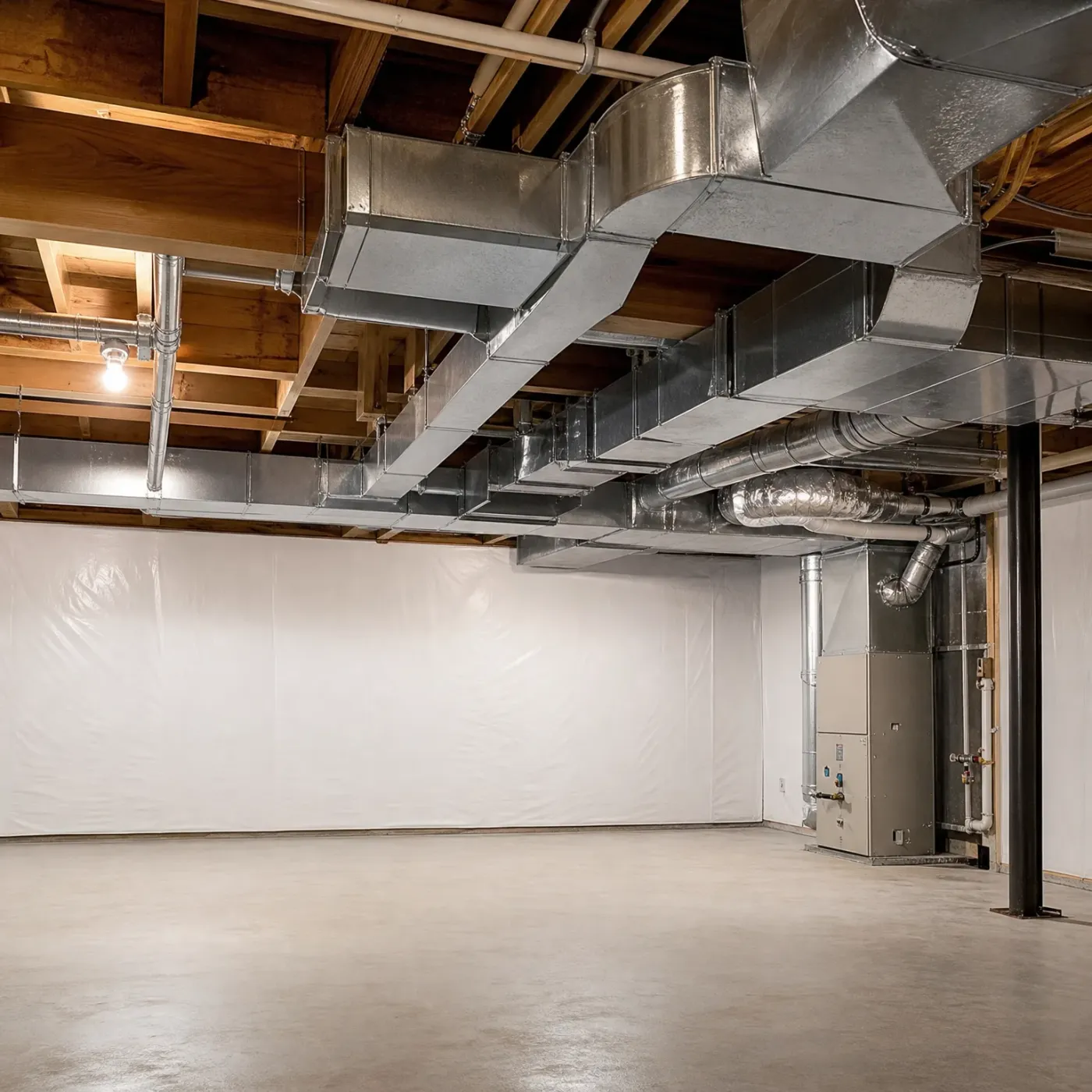
Empty basement with bare concrete floor, white plastic sheeting over one wall, exposed wood joists, galvanized sheet-metal ductwork and pipes overhead, and a furnace unit with a steel support column at right.

Ductwork running clean

This is what a duct system looks like when air moves through it the way it should. The sheet metal stays dry, the joints stay sealed, and the basement around it stays free of the damp that gives mold a place to start. Air passing through here picks up nothing on the way to your rooms.
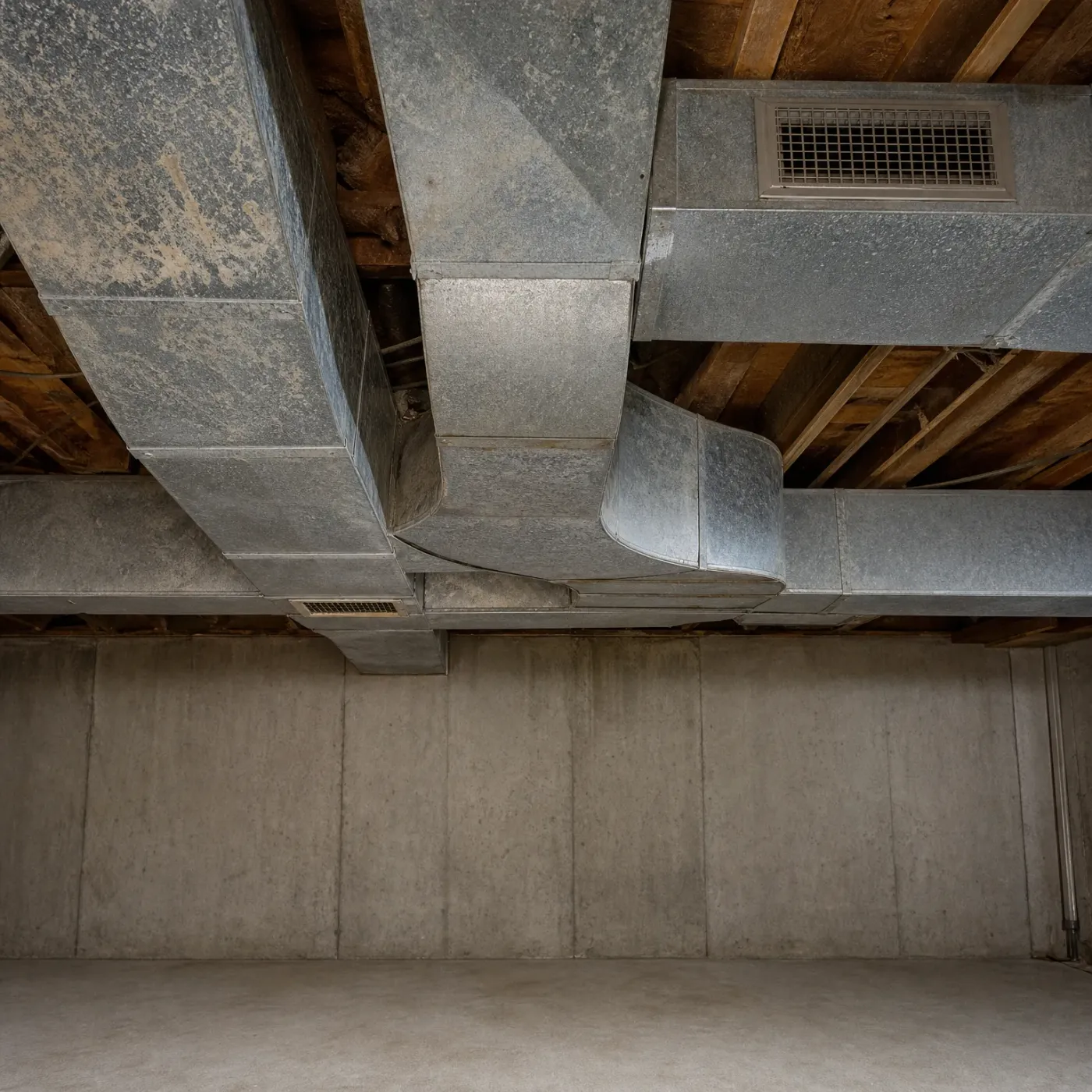
Galvanized sheet metal HVAC ducts with vent grilles run along a wooden floor joist ceiling above bare concrete walls and floor in an unfinished basement.

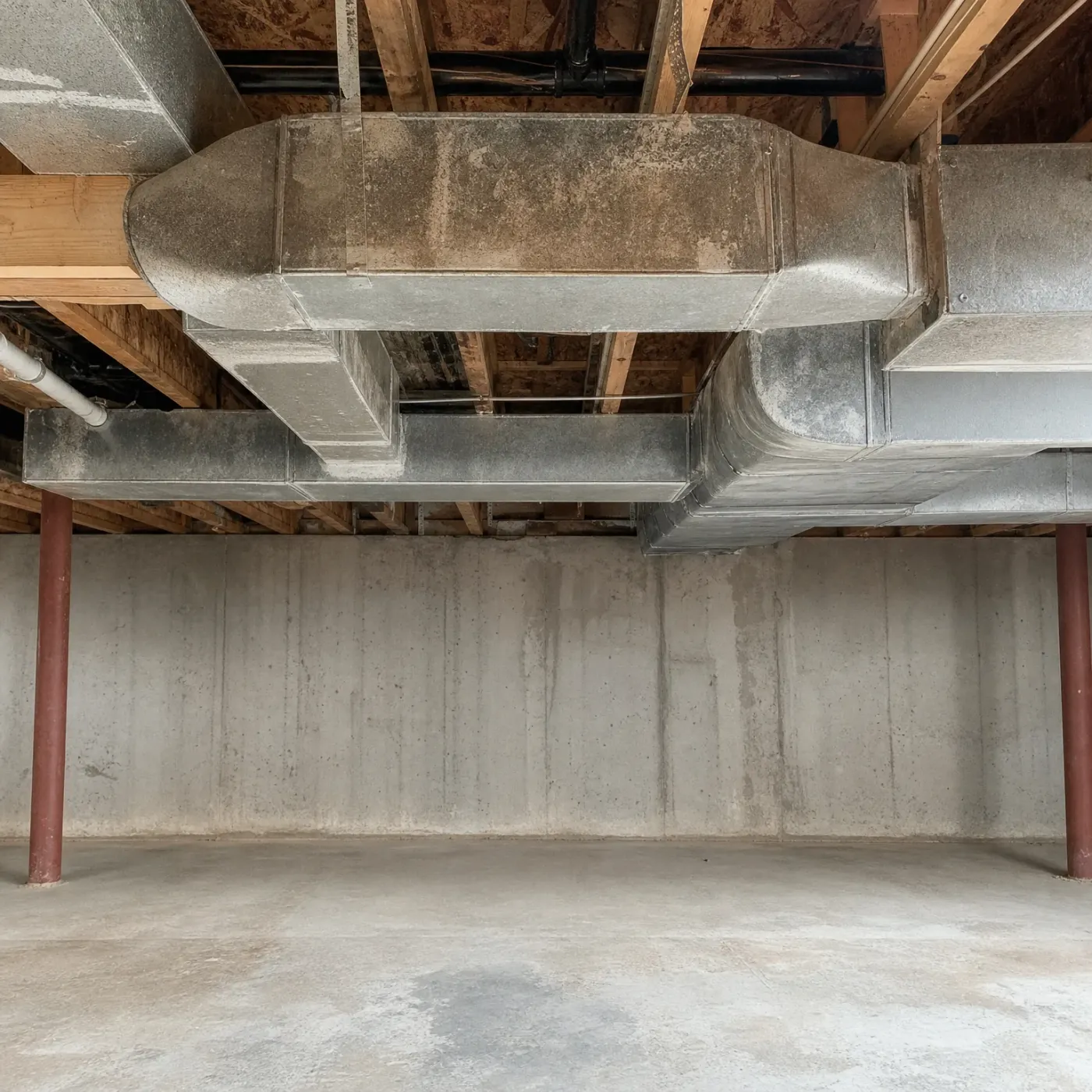
Ductwork under strain

Here the same runs sit lower, closer to the slab, carrying air past seams and turns where dust has had time to settle. Against bare concrete and an unfinished basement, moisture collects on those walls more easily, and every bend is a spot where buildup can start before you ever smell it upstairs.

Unfinished basement with bare concrete walls and floor, galvanized sheet-metal HVAC ducts running beneath wooden floor joists, and two red steel support columns.
Before you get your ductwork cleaning
Unfinished basement with poured concrete walls, a bare concrete floor, white PVC pipes running down the wall, and exposed sheet-metal HVAC ductwork beneath wood floor joists.
After you get your ductwork cleaning

Is it the ducts or the coil

Smell from the ducts

  • The smell is even whether the air handler is running or not, since it's coming off dust sitting in the supply and return runs.
  • You'd notice it in rooms far from the furnace or air handler, not just the one closest to it.
  • Opening a floor register near the end of a run can make the smell stronger than one near the air handler.
  • Cleaning the ducts clears the film and dust off the interior walls where the odor is sitting.
  • If the ductwork was never cleaned after the house was built, this is the more likely source.

Smell from the coil

  • The smell shows up strongest right when the air kicks on and fades as the system keeps running.
  • It's usually strongest near the vents closest to the air handler, not spread evenly through the house.
  • A dirty or wet evaporator coil holds moisture against metal fins, which is a different setup from dust in sheet metal.
  • Cleaning the coil is a separate job from duct cleaning and doesn't touch the ductwork itself.
  • If the smell started suddenly during a stretch of heavy humidity, the coil is worth checking first.
  1. A technician opens the supply and return runs at several points.

  2. A negative air machine connects to the ductwork to pull air through.

  3. A rotating brush or air whip knocks dust loose from the duct walls.

  4. That loosened dust and film gets vacuumed out under negative pressure.

A man in a dark jacket and khaki pants walks through an open gate in a stone wall toward a woman standing in the open front doorway of a single-story white house with a dark shingled roof and river-rock accents.

A musty smell from the vents has a cause, and it can be dealt with

The smell is dust and film built up on the duct walls, holding moisture long enough for mold to take hold. It's not the furnace and it's not the air handler. It's the ductwork itself, and cleaning it out is what clears the smell for good.

A technician who works on duct systems around Waukegan every season has seen this before, in homes with the same mix of older ductwork and long, humid summers. Once you request service, one licensed local contractor who takes on this kind of job reaches out to you directly, and looks at your ducts with that experience behind them. You'll know what's really going on in your system, and what it takes to get the air moving clean again.

Interior corner of a living room with a beige upholstered armchair holding a textured pillow and throw, a eucalyptus arrangement in a ceramic vase on a wooden table in the foreground, a blurred glass-front cabinet behind, and a potted plant on a sunlit window sill.
A woman wrapped in a chunky knit blanket sits in an armchair with an open book on her lap, beside a lit table lamp and a window with frost and snow outside.
A smiling older woman with gray shoulder-length hair in a cream cable-knit turtleneck sweater stands behind a wooden board holding a round loaf of bread, in a warmly lit kitchen with a dark window and shelves behind her.

Ductwork Cleaning

Find a duct system cleaning pro in Lake County

A licensed pro who works in Lake County gets your request.

A black-framed smartphone standing upright against a plain light gray background, its screen filled with solid green.
Duct and vent cleaningDucts or ventsLake County, IL
Step 1 of 2

What ZIP code is the job in?