Musty air when the furnace or AC kicks on, dark spots around a vent, or a mold smell that won't go away points to the ducts themselves. With Chicago's muggy summers and humid basements, that moisture has to come from somewhere. This page gets into what causes it and what to check in your own home, plus how to get matched with a local contractor who deals with duct systems like yours.
A musty smell from the vents or dark spots around a register usually means mold is growing somewhere inside the duct run, often on the coil or in the drain pan nearby where condensation collects. Chicago summers run humid, and when warm, damp air moves through a duct that's cooler than the air around it, moisture beads up on the inside walls. That dampness, sitting in a dark duct with dust to feed on, is what mold needs. A lot of Cook County basements add to it, since a basement's naturally damper air gets pulled into the return side of the system. Mold in the ducts doesn't stay put. Spores move through the house every time the blower runs, which is why the smell shows up in rooms far from the furnace. It's also why the problem doesn't go away on its own and tends to get worse the longer the moisture source stays unaddressed.
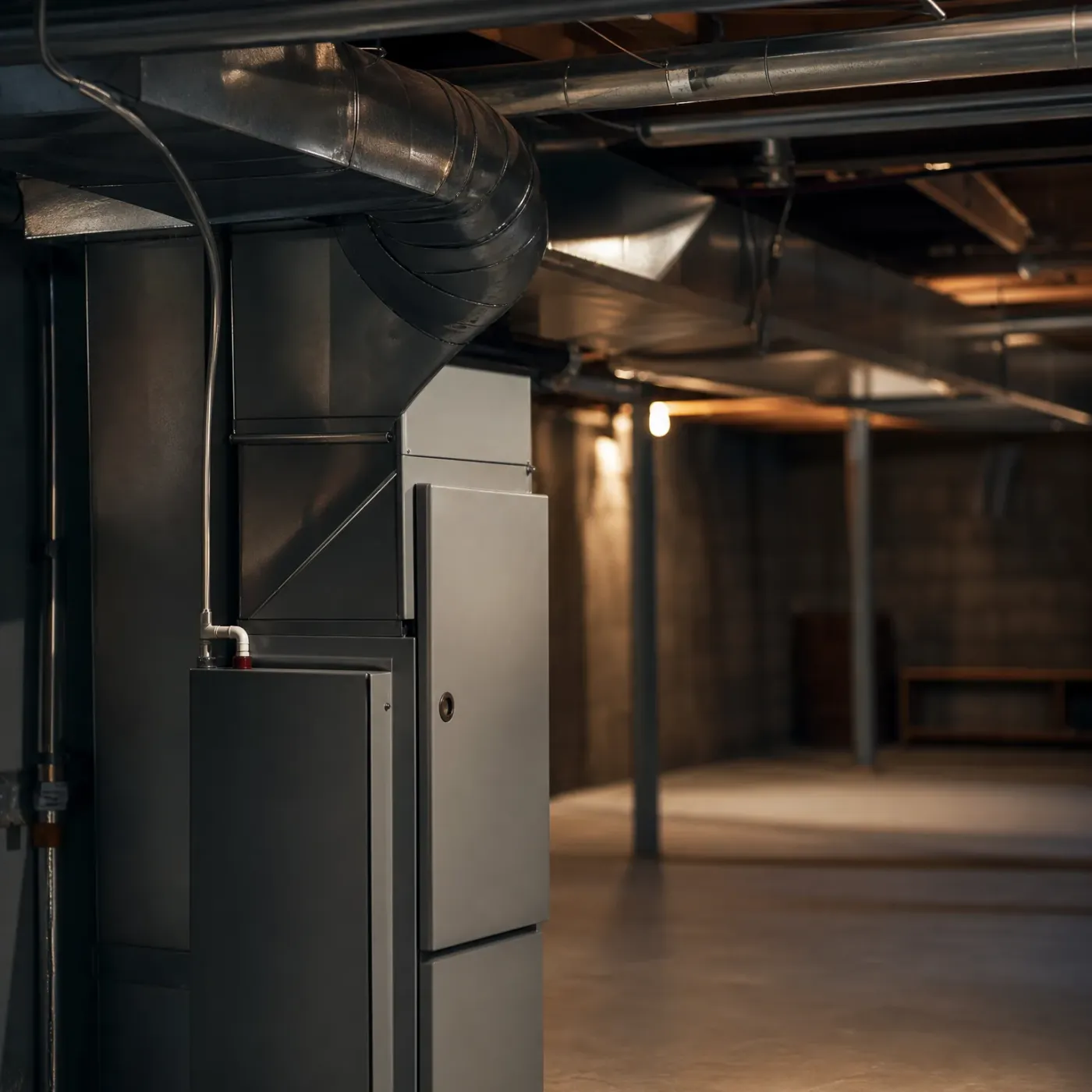
Clean metal ducts, dry joists, and no staining where the branch lines meet the plenum.
Dark staining along the duct seams and joists, a sign moisture is collecting instead of draining off.
Most duct mold traces back to the evaporator coil. It pulls moisture out of the air every time the AC runs, so it stays wet long after the system shuts off. That water is supposed to drain off through the condensate pan and a small PVC line. When that line clogs, which happens more than people expect, the pan overflows and the duct section closest to it stays damp. Mold only needs two things to grow: moisture and something to feed on, and the dust already sitting in your ducts covers the second part. If your system uses flex duct or duct board anywhere, check those sections first, since they hold moisture longer than sheet metal and tend to show mold sooner. A duct run through a crawlspace or garage can grow mold a different way too. The outside of the duct sweats in Chicago's humid summers, and that moisture soaks in without any leak or clog involved at all.
Where duct mold actually starts
The evaporator coil sits right at the air handler, and its job of pulling moisture out of the air leaves it wet for hours after the AC shuts off.
That water is supposed to drip into a condensate pan and drain out through a small PVC line, not sit around.
A clogged drain line backs the pan up, and once it overflows, the nearest duct section stays damp long enough for mold to take hold.
Mold needs organic matter to feed on, and the dust and debris already sitting inside your ducts give it exactly that.
Flex duct and duct board hold onto moisture longer than bare sheet metal, so mold shows up there first if it's part of your system.
A duct run that passes through an unconditioned space, like a crawlspace or garage, can sweat on the outside and grow mold without any leak inside it at all.
Your request goes to one pro, not a list of companies.
Sending the form costs nothing.
What This Means for Your House
Every pass through moldy ducts carries spores into bedrooms and the living room, not just near the vent.
Anyone in the house with asthma or allergies may notice more coughing or stuffiness once the AC or furnace is running regularly.
The musty smell tends to settle into carpet, curtains, and upholstery, so it lingers even when the system is off.
A basement return duct sitting near a damp slab gives mold a steady supply of moisture to keep growing on.
Mold inside the ducts can spread to nearby wood framing or insulation if the moisture source isn't addressed.
Left alone through another humid Chicago summer, the staining and smell usually get worse, not better.
Mold in the ducts doesn't stay put. Every time the furnace or AC cycles on, air moves through the whole system and out through every vent in the house, carrying whatever is growing in there along with it. That's why the smell shows up in bedrooms down the hall, not just near the return. If anyone in the house has asthma or is sensitive to allergens, running the system more in the deep summer heat or the cold months can make that worse rather than better. The smell itself works its way into fabric. Carpet, curtains, and upholstery hold onto it, so you'll notice it even on a mild day with the system off. Where the mold is matters too. A return duct running near a damp basement slab has a steady moisture source, which means the mold has what it needs to keep spreading rather than dry out and stop. Once it reaches the wood framing or insulation around the ductwork, that's a different, bigger job than cleaning the duct run itself. None of this fixes itself. Another Chicago summer of humidity moving through a duct system that already has mold in it tends to leave more staining and a stronger smell by September, not less. The moisture source has to be dealt with, and the mold that's already grown has to be cleaned out, or the house just keeps feeding it.
Before you get your ductwork cleaningAfter you get your ductwork cleaning
Ducts doing their job
Metal ductwork like this moves air without holding onto moisture. The joists stay dry, the sheet metal stays clean, and nothing in the basement smells off when the furnace or AC runs. Air passes through and that's the end of it.
Ducts holding onto moisture
Same kind of basement, same sheet-metal runs overhead, but nothing is draining the way it should. Moisture sitting in the ducts gives mold a place to grow, and every cycle of the furnace or AC pushes that air through the house.
Why does duct mold keep coming back in Cook County homes?
Half the homes here were built by 1961
Half the homes in Cook County were built in 1961 or earlier. Older ductwork has more seams and joints where moisture settles and mold gets a foothold.
Heat runs October through May
Heat runs here from October through May, about eight months of the year. That's eight months of the furnace pushing air through ducts that may already be holding moisture.
Cooling runs June through August
Cooling runs June through August. Those three humid months are when the coil sweats hardest and ducts are most likely to stay damp between cycles.
ACS 2020-2024 · NOAA nClimDiv 1991-2020
A musty smell from the vents means mold has a place to grow
If the air coming out of your vents smells musty, or there's staining around a register, something inside that duct run is wet enough to hold mold. In a Cook County house, that's usually the coil or the drain pan where condensation collects before it's supposed to drain away. Cleaning the ducts clears what's already there, but it doesn't change whatever let the moisture sit in the first place.
A contractor who works on ductwork around Chicago every summer has seen which parts of a system tend to hold water and which don't, and can tell you which one is happening in your house. Once you request service, you're matched with one licensed local contractor who takes a look at your situation and reaches out directly, rather than a handful of companies competing for the job. You'll know where things stand with your ducts, and what, if anything, needs to happen next.
Ductwork Cleaning
A local pro for your ductwork cleaning
The pro who gets in touch is licensed in Illinois and works in Cook County.