Mini Split Installation in DeKalb, IL
A new system here will heat from October through May and cool from June through August every year. Tell us about the house, and a licensed contractor who covers DeKalb County will get in touch.
Tell us about the job
It takes about a minute.
What DeKalb winters ask of a mini-split
Your mini-split has to work most of the year here. Homes in DeKalb County need heat or cooling 11 months out of the year, with winter running October through May and summer covering June through August. That is a long stretch on the compressor in both directions, not just one.
Winter nights average 17°F from December through February, cold enough that a heat pump has to work for its keep. Any mini-split installed new has to meet 14.3 SEER2 for cooling and 7.5 HSPF2 for heating, the federal minimum for split-system heat pumps since January 2023. That is the floor, not a target, so it is worth asking what a contractor is installing above it for a season this long.
- 8 months
- October through May, your system heats
- 3 months
- June through August, it cools
- 17°F
- the average winter night it heats against
- 82°F
- the average summer afternoon it cools against
NOAA nClimDiv, 1991–2020 normals
In Illinois, HVAC licensing for homes is left to the cities and towns.
Whether there's any licensing rule at all depends on which city or town the house is in, since Illinois leaves that decision to local government rather than setting a state rule. Some places license HVAC contractors, some register them, and some have no rule on the books at all, so there is no single answer for DeKalb County. It comes down to the address.
For a mini-split installation, most cities and counties require a permit from the local building office, with an inspection once the work is done. That inspection is what puts a second set of eyes on the installation, checking that it was done correctly regardless of whether the town has its own licensing rule for contractors.
Source: Illinois General Assembly
- Is a mini split worth it?
- For the right room or addition, yes. A mini split heats and cools without ductwork, so it makes sense in a room that never got comfortable, a garage conversion, or an addition that never got tied into the main system. With DeKalb winters averaging 17°F and homes here needing heat or cooling 11 months of the year, a unit sized for the space you're adding it to will earn its keep. Whether it beats other options for your situation is something a contractor should size up in person.
- How many rooms can a mini split cover?
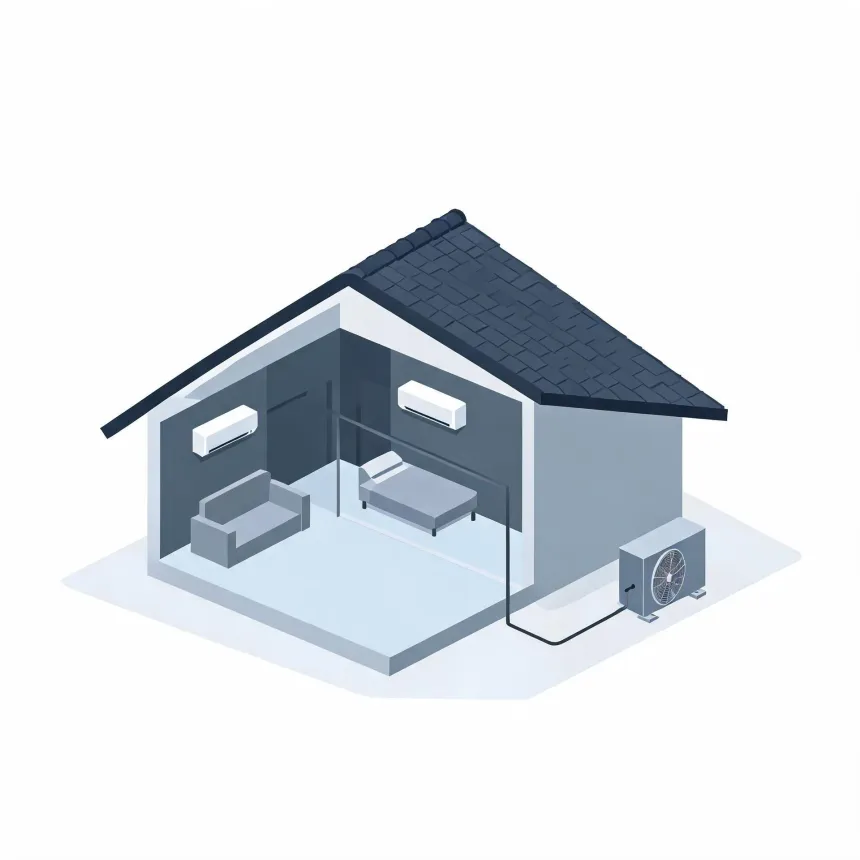
- A single-zone system heats and cools one room or open area. If you need to cover more rooms, a multi-zone system runs several indoor units off one outdoor condenser, and each indoor unit handles its own room with its own thermostat. The number of zones a given outdoor unit can support depends on the equipment, so a contractor will work that out based on the rooms you want covered and how they're laid out.
- Can a mini split heat a whole house?
- It can, but it takes the right setup. A multi-zone mini split with enough indoor units, sized and placed to cover every room, can heat an entire house instead of just one area. DeKalb winter nights average 17°F from December through February, so the heat pump chosen for that job needs to be rated to perform down at those temperatures, not just sized for square footage. A contractor can look at the house and tell you whether whole-house coverage makes sense there or whether it works better alongside the existing heat source.