Mini Split Installation in Danville, IL
A new system here will heat from October through May and cool from June through September every year. Tell us about the house, and a licensed contractor who covers Vermilion County will get in touch.
Tell us about the job
It takes about a minute.
What a mini-split has to handle in Danville
Danville needs heat or cooling all year. Winter nights average 21°F from December through February, and a mini-split has to keep putting out heat at that temperature. Summer afternoons average 84°F, so the same system carries the cooling load for the four months of June through September.
A mini-split installed new has to meet the federal minimum for split-system heat pumps. That means 14.3 SEER2 for cooling and 7.5 HSPF2 for heating. That is the floor, so it is worth asking what rating the unit going in actually carries. Vermilion County has seen 7 winter storms and 163 damaging wind events over the last ten years, and a mini-split, like most heat pumps, comes back on by itself once power is restored.
- 8 months
- October through May, your system heats
- 4 months
- June through September, it cools
- 21°F
- the average winter night it heats against
- 84°F
- the average summer afternoon it cools against
NOAA nClimDiv, 1991–2020 normals
In Illinois, HVAC licensing for homes is left to the cities and towns.
Vermilion County does not run its own contractor license either. Illinois leaves that decision to cities and towns, so whether an installer needs a local license depends on which town the house is in. Where a town has that rule, the license is on file with that town, not the state. Where a town has no such rule, there is no license record anywhere.
What covers this job here is the permit. In most cities and counties, installing a mini-split needs a permit from the local building office and an inspection once the work is done. That inspection is what checks the installation was done right. Nobody in Illinois checks that the installer holds a state license, because there is not one.
Source: Illinois General Assembly
- Is a mini split worth it?
- For the right room or space, yes. A mini split heats and cools without ductwork, so it works well for an addition, a garage, or a house that relies on space heaters or window units. Danville sees winter lows near 21°F, and a mini split with a heat pump can still pull heat from that cold air, though the coldest nights are where it works hardest. Whether it beats what you have now depends on your current setup, and that's worth going over with a contractor before you decide.
- How many rooms can a mini split cover?
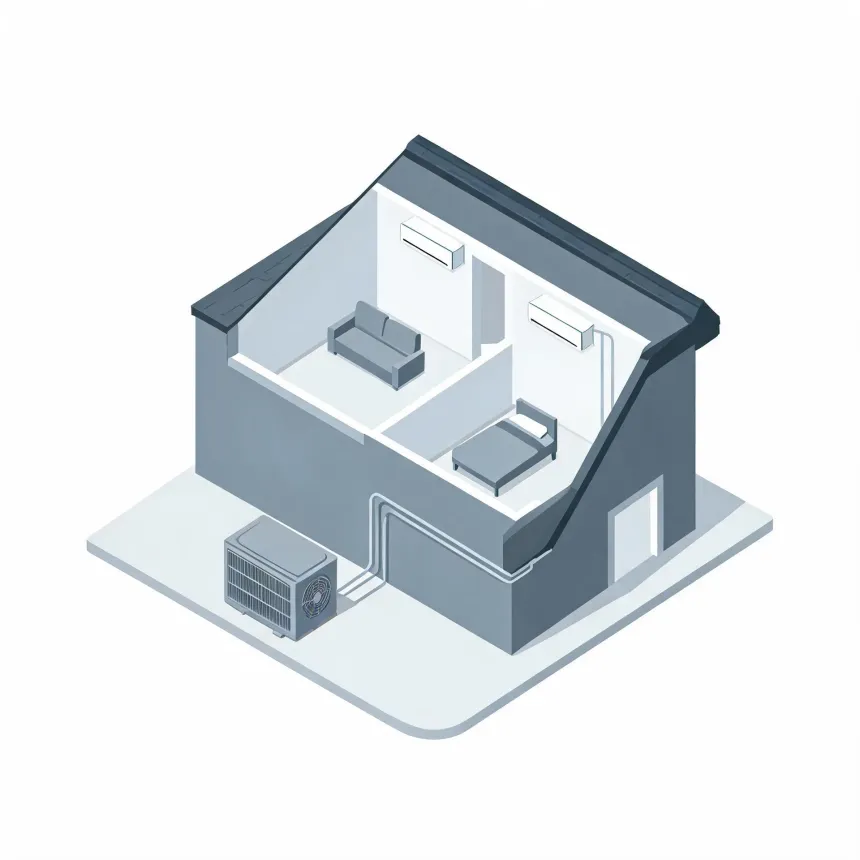
- A single outdoor unit can run one indoor head or several, depending on the system. Single-zone systems cover one room or open area well. Multi-zone systems run several indoor heads off one outdoor unit, each with its own thermostat, which works for covering a few separate rooms without ductwork. The right number for your house depends on square footage and layout, and a contractor can walk the rooms with you to size it.
- Can a mini split heat a whole house?
- It can, if it's sized and placed for that. A multi-zone system with enough indoor heads can heat every room, and whole-house ductless setups are common in homes without existing ductwork. The question in Danville is how the system handles those 21°F nights that run from December through February, since heat pump output drops as the air gets colder. A contractor can size the system and tell you whether it will carry the house on its own or work best alongside backup heat for the coldest stretches.