Mini Split Installation in Champaign, IL
A new system here will heat from October through May and cool from June through September every year. Tell us about the house, and a licensed contractor who covers Champaign County will get in touch.
Tell us about the job
It takes about a minute.
What Champaign winters ask of a mini-split
Champaign homes need heat eight months a year, October through May, and winter nights average 21°F. A mini-split installed here has to hold up on nights well below freezing, not just take the edge off in fall and spring. Summers run four months with afternoons averaging 84°F, so the same unit switches to cooling not long after the heat season ends.
Any mini-split manufactured from 2023 on has to meet 14.3 SEER2 for cooling and 7.5 HSPF2 for heating, whether it runs on ducts or not. That heating number matters more here than in most places, since this system is doing real work eight months out of twelve.
- 8 months
- October through May, your system heats
- 4 months
- June through September, it cools
- 21°F
- the average winter night it heats against
- 84°F
- the average summer afternoon it cools against
NOAA nClimDiv, 1991–2020 normals
In Illinois, HVAC licensing for homes is left to the cities and towns.
Champaign County does not run its own contractor license either. Illinois leaves that decision to cities and towns, so whether a license is required here depends on the specific city or township the house sits in. Where a local license exists, it means that town tested and keeps a record of the contractor. Where none exists, there is no such record at all, and the county adds nothing on top of whatever the local municipality does or does not require.
For a mini-split installation, the protection that reliably applies here is the permit and inspection process. Most local building offices require a permit for this kind of work and send someone out to inspect it once it is done. That inspection is what catches a bad installation in this county, not a license, since none is guaranteed to exist depending on where the house sits.
Source: Illinois General Assembly
- Is a mini split worth it?
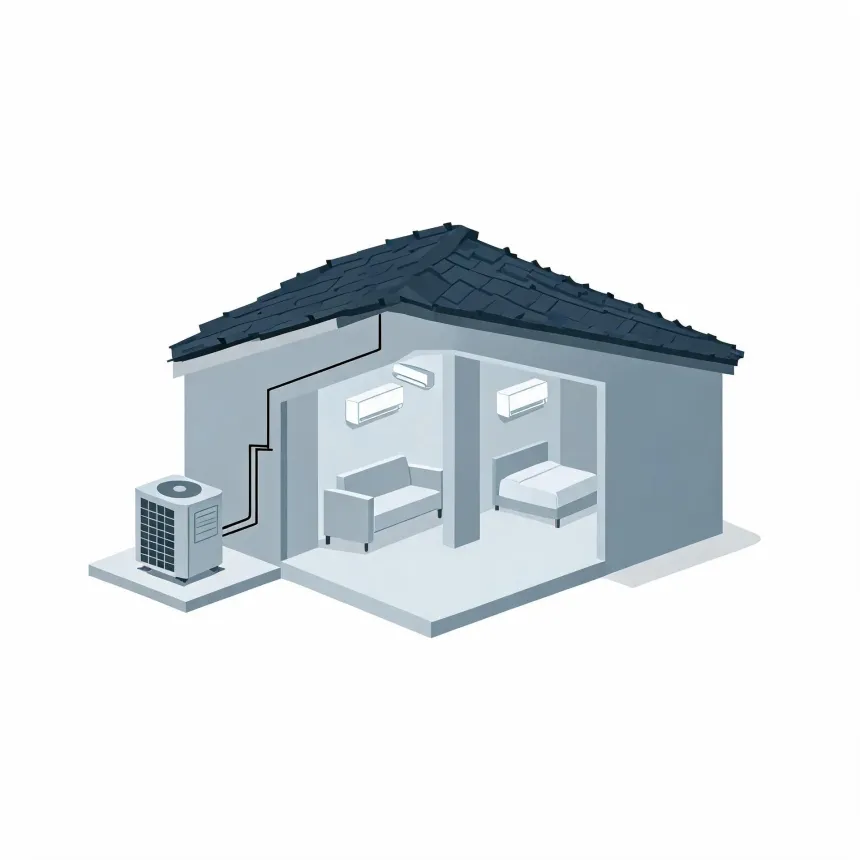
- For the right room, yes. A mini split heats and cools one room or zone directly, without ductwork, so it works well for an addition, a garage, or a room that never gets comfortable off the main system. Your winters here get down to 21°F on average overnight, so if you're leaning on it as your only heat in a room, check that the unit you're getting is rated to keep up at that temperature. Some cold-climate models are, some aren't.
- How many rooms can a mini split cover?
- A single indoor head is built for one room or one open space. If you need to cover more than that, a multi-zone system lets one outdoor unit run several indoor heads, up to eight on some systems, each with its own thermostat. The tradeoff is that each zone costs more to add, so most homes use mini splits for the rooms that actually need help rather than trying to cover the whole house zone by zone.
- Can a mini split heat a whole house?
- It can, but it takes more than one indoor unit to do it. A single head only heats the room it's in, so a whole-house setup means a multi-zone system with a head in each main area, sized and placed to cover the floor plan. Winters here run cold enough, down to 21°F on average overnight, that a contractor should confirm the system you're considering is rated to keep up on the coldest nights before you count on it as your only heat.