
HVAC Repair in Aurora, IL
Homes here need heat from October through May and cooling from June through August. If your system quits, tell us what it's doing and a licensed contractor who covers Kane County will get in touch.
Tell us about the job
It takes about a minute.

Eleven months of work, in Kane County swings
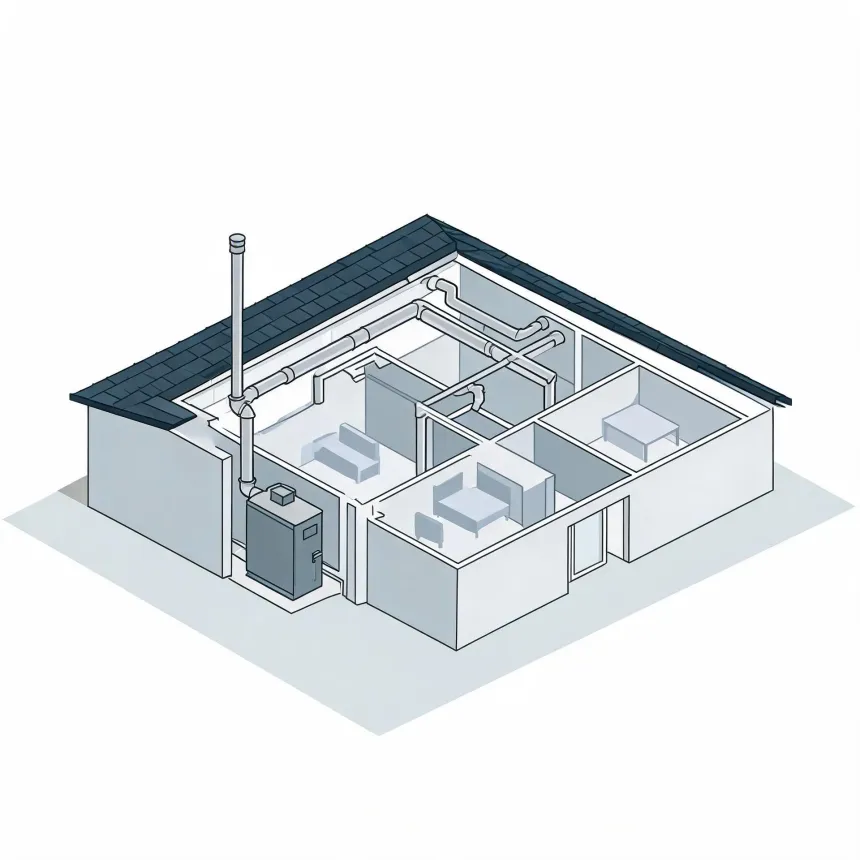
Your furnace is the one doing most of the work here. Kane County needs heat from October through May, and on winter nights averaging 18°F it runs long and often, cycling on again each time the house drops a few degrees. That kind of use wears on the igniter and the burner assembly first. When the igniter goes, the furnace runs but never lights, and the house just gets colder.
Summer is short here, three months, but the afternoons average 82°F and the air conditioner has to work against that heat with no break for days at a time. That load falls on the compressor and the capacitor that starts it. When the capacitor weakens, the outdoor unit hums but the fan never turns, and the house stops cooling right when you need it most. Kane County has also seen 190 damaging wind events and 19 winter storms over the past ten years, and power loss is common enough that 16% of Illinois households went at least a day without it in 2024. Most furnaces and air conditioners come back on their own once power returns, but a system already struggling with a worn part may not recover the same way.
- 8 months
- October through May, your system heats
- 3 months
- June through August, it cools
- 18°F
- the average winter night it heats against
- 82°F
- the average summer afternoon it cools against
NOAA nClimDiv, 1991–2020 normals
A new furnace and air conditioner would cut about $160 a year off heating and cooling for a typical Kane County home.
Estimates for a typical Kane County home, compared with an older unit built to the previous federal minimum, from EIA household energy data, Illinois fuel prices and NOAA climate normals. Your home will differ.
Repair makes sense when one part has failed.
Replacement makes sense when the furnace's heat exchanger is cracked, the air conditioner's compressor has failed, or repairs keep coming.
In Illinois, HVAC licensing for homes is left to the cities and towns.
Check whether your city requires a license.
Source: Illinois General Assembly
- Why is my heat not working?
- Start with the thermostat. Make sure it is set to heat and the temperature is set above the room temperature, since a setting bumped a degree or two can look like a dead furnace. Check the breaker next, since a tripped breaker will shut a furnace down with no warning. If those are fine, look at the air filter. A filter clogged with dust can choke off airflow until the furnace overheats and shuts itself off as a safety measure. With winter nights here dropping to 18°F on average, a furnace that will not stay on needs attention the same day.
- Why is my system running but not cooling the house?
- The most common cause is a dirty air filter blocking airflow across the indoor coil. When that coil cannot pull enough warm air over it, it can ice up, and iced coil moves no cold air even though the system is running. Check the filter first and replace it if it is gray or clogged. If the filter is clean and the air coming from the vents is warm or weak, the system needs a contractor to look at it, since low refrigerant or a failing compressor are not something to diagnose from inside the house.
- What can I check before calling for HVAC repair?
- Check the thermostat settings first, since the wrong mode or a setting left untouched from last season explains a lot of no-heat and no-cool calls. Check the breaker panel for anything tripped. Look at the air filter and replace it if it is dirty, since restricted airflow causes problems in both furnaces and air conditioners. If the system has an outdoor unit, make sure nothing is blocking it, like snow, ice, or leaves. If you have gone through these and the system still is not heating or cooling, a contractor will need to look at it directly.