Mini Split Installation in Springfield, IL
A new system here will heat from October through April and cool from May through September every year. Tell us about the house, and a licensed contractor who covers Sangamon County will get in touch.
Tell us about the job
It takes about a minute.
Sangamon County asks a mini-split to run nearly all year
Winter nights here average 22°F, and a mini-split has to keep pulling heat out of that cold air from October through April. Summer afternoons average 85°F, so the same system switches to cooling for May through September. That is seven months of heating and five of cooling, which leaves the unit idle only a few weeks a year.
Any mini-split heat pump built since January 1, 2023 has to meet 14.3 SEER2 for cooling and 7.5 HSPF2 for heating, so that floor is already set before you choose a unit. Storms are part of the picture too. Sangamon County has seen 198 damaging wind events and 7 winter storms over the past ten years, and 16% of Illinois households lost power for at least a day in 2024. A mini-split that loses power stops heating or cooling until it comes back, same as any other system.
- 7 months
- October through April, your system heats
- 5 months
- May through September, it cools
- 22°F
- the average winter night it heats against
- 85°F
- the average summer afternoon it cools against
NOAA nClimDiv, 1991–2020 normals
In Illinois, HVAC licensing for homes is left to the cities and towns.
Sangamon County does not run its own state license either, since Illinois leaves the decision to cities and towns. Whether this contractor needs to be licensed for the job comes down to what the local city or township requires, and that varies by address. There is no state list of licensed HVAC contractors to check, because there is no state requirement behind one.
What covers this job instead is the permit. A mini-split installation in most cities and counties needs a permit from the local building office, and the finished work gets an inspection before it is signed off. That inspection is what catches a line set connection done wrong or a unit mounted badly, the kind of problem a license would otherwise guard against.
Source: Illinois General Assembly
- Is a mini split worth it?
- For the right room or addition, yes. A mini split heats and cools one space well without extending ductwork, and it keeps working room by room even if the rest of your system is off. Your winters here run cold, down to 22°F on average overnight from December through February, so check that the unit you're looking at is rated for that kind of cold. Most cooling-season heat pumps sold now meet 14.3 SEER2 and 7.5 HSPF2 minimums, but low-temperature performance still varies by model.
- How many rooms can a mini split cover?
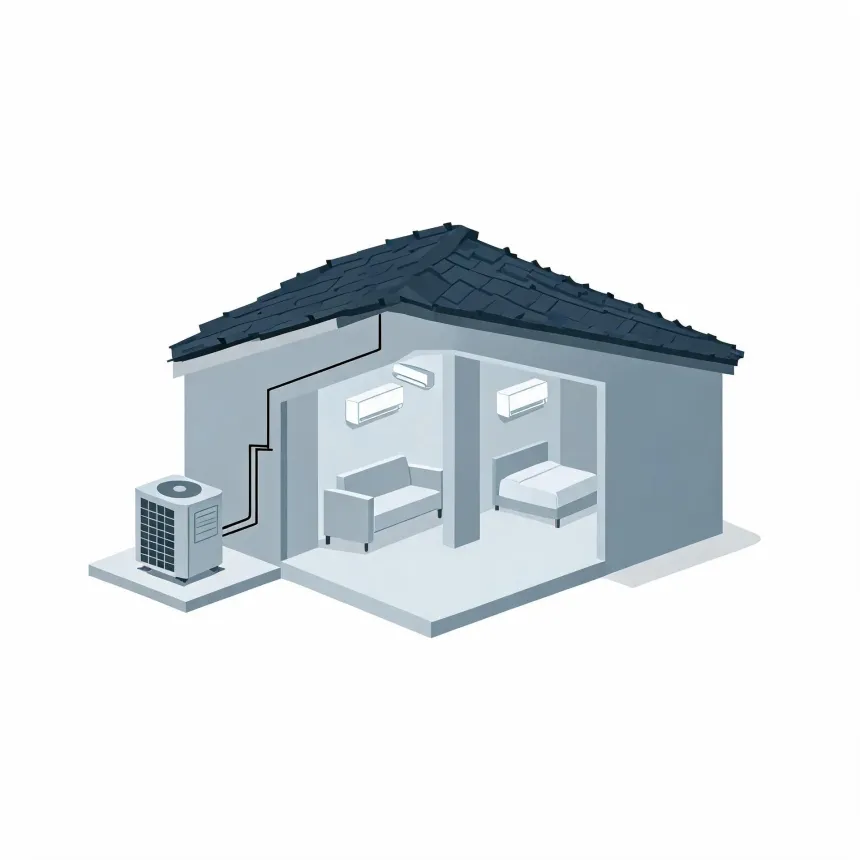
- A single indoor head is built for one room or one open space. If you need more rooms covered, a multi-zone system lets one outdoor unit run several indoor heads, each with its own thermostat. The tradeoff is that every added zone splits the outdoor unit's capacity, so a contractor needs to size it against your actual rooms, not just count doors.
- Can a mini split heat a whole house?
- It can, if it's sized and placed for that from the start. A multi-zone system with a head in each main room can carry the whole house through the year, including the 22°F nights you get here from December through February. Whether it makes sense to run it as your only heat or alongside your gas furnace, which is what 73.2% of homes here already have, comes down to how the house is laid out. That's a sizing question a contractor needs to walk through room by room.